Quick Answer: JFK to Manhattan
The trip from JFK to Manhattan is roughly 17 miles and usually takes around 35–50 minutes in light traffic, while rush hour, roadwork, or bad weather can push the journey closer to 60–90 minutes. Travelers can choose between a private car, yellow taxi, AirTrain + LIRR, AirTrain + subway, or rideshare depending on budget, luggage, arrival time, and final destination. For families, business travelers, late-night arrivals, or passengers carrying multiple bags, JFKShuttles.com offers a more predictable door-to-door option with flat-rate booking, flight tracking, meet-and-greet service, and a choice of sedans, SUVs, and Sprinter vans.
Call: (718) 878-1383
Book online: Get a quote
Introduction
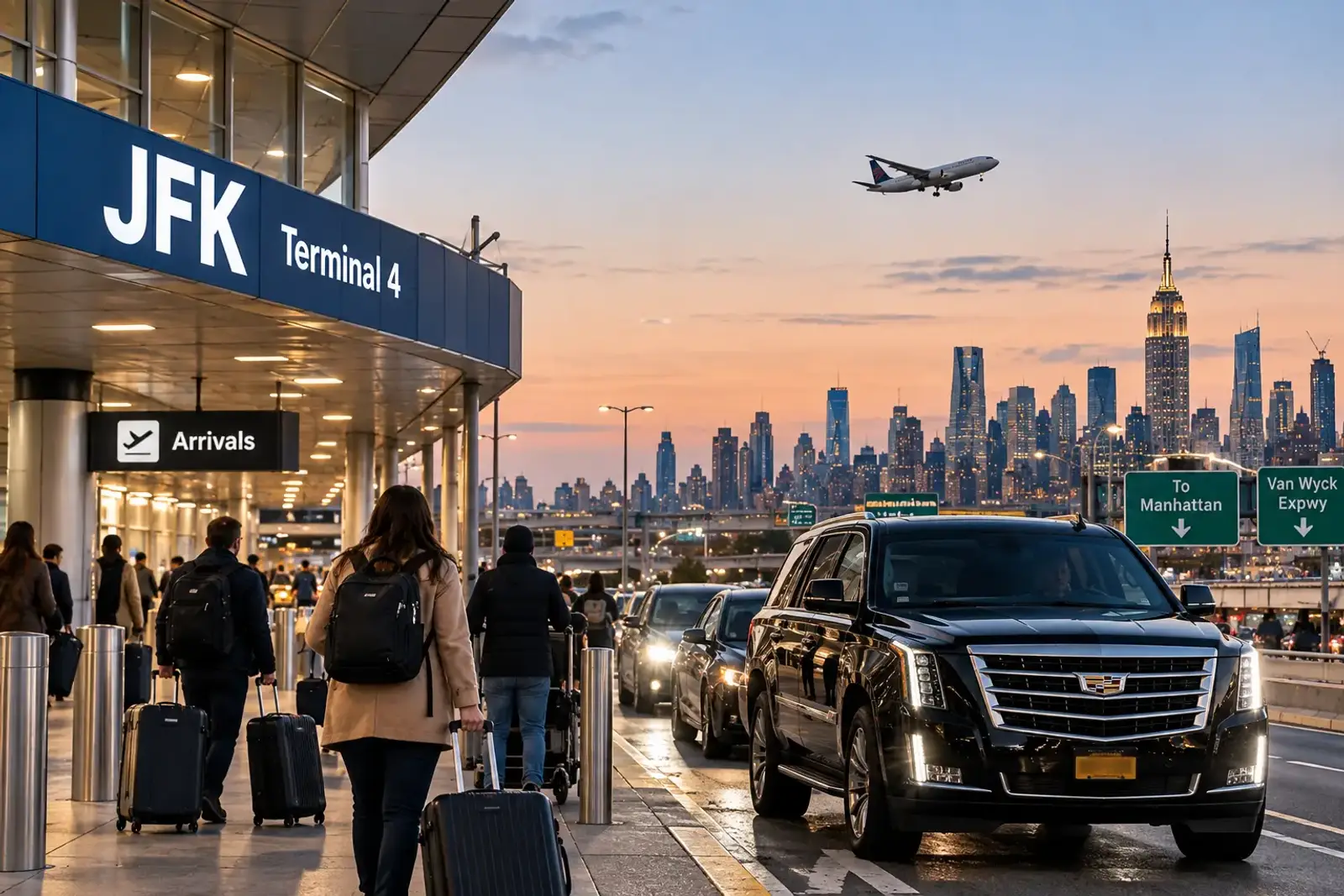
Traveling JFK to Manhattan covers roughly 17 miles, depending on your final destination. A common driving route to Midtown uses the Van Wyck Expressway, Long Island Expressway and Queens-Midtown Tunnel. Under light traffic, the drive can take around 35–50 minutes; during busy periods, construction or weekday rush hour, allow 60–90 minutes or more. For business travelers, families, late-night arrivals and passengers traveling with checked luggage, a pre-booked private car is usually the most predictable door-to-door option because the vehicle, pickup and price are arranged before arrival.
JFKShuttles.com provides 24/7 TLC-licensed private airport transfers with flight tracking, meet-and-greet service, sedans, SUVs and Sprinter vans.
Option 1: (JFKShuttles) Private Car Service (Best for Most Travelers)
A JFK to Manhattan car service works differently from transportation you arrange after walking out of the terminal.
You book before your flight, provide your arrival information and receive a confirmed rate for the trip. The transportation company can monitor your flight so the pickup is coordinated around your actual arrival rather than simply the scheduled landing time.
With meet-and-greet service, your chauffeur can meet you at the arranged arrivals location with a name sign. Depending on airport operations, terminal construction and your preference, a coordinated curbside or designated pickup may also be available.
How Long Does a Private Car Take?
Traffic matters more than the vehicle.
- Light/off-peak traffic: about 35–50 minutes
- Normal daytime traffic: about 45–65 minutes
- Weekday evening rush, especially 4–7 PM: about 60–90 minutes
- Major incidents, severe weather or construction: potentially longer
The benefit is not that a private vehicle can somehow avoid New York traffic. It cannot.
The benefit is eliminating several other variables: searching for transportation after landing, waiting in a taxi line, transferring between trains and carrying luggage through multiple stations.
A private airport transfer makes the most sense for:
- Business travelers on a schedule
- Families or small groups
- First-time New York visitors
- Travelers arriving late at night
- Passengers with two or more bags
- Groups needing an SUV or Sprinter van
- Travelers who want to know their transportation price before pickup
It may not be necessary for everyone.
If you are traveling alone with one backpack, arriving during a quiet part of the day and staying close to Penn Station, public transportation can be faster or significantly cheaper.
For those trips, AirTrain and rail are worth considering.
Option 2: Yellow Taxi
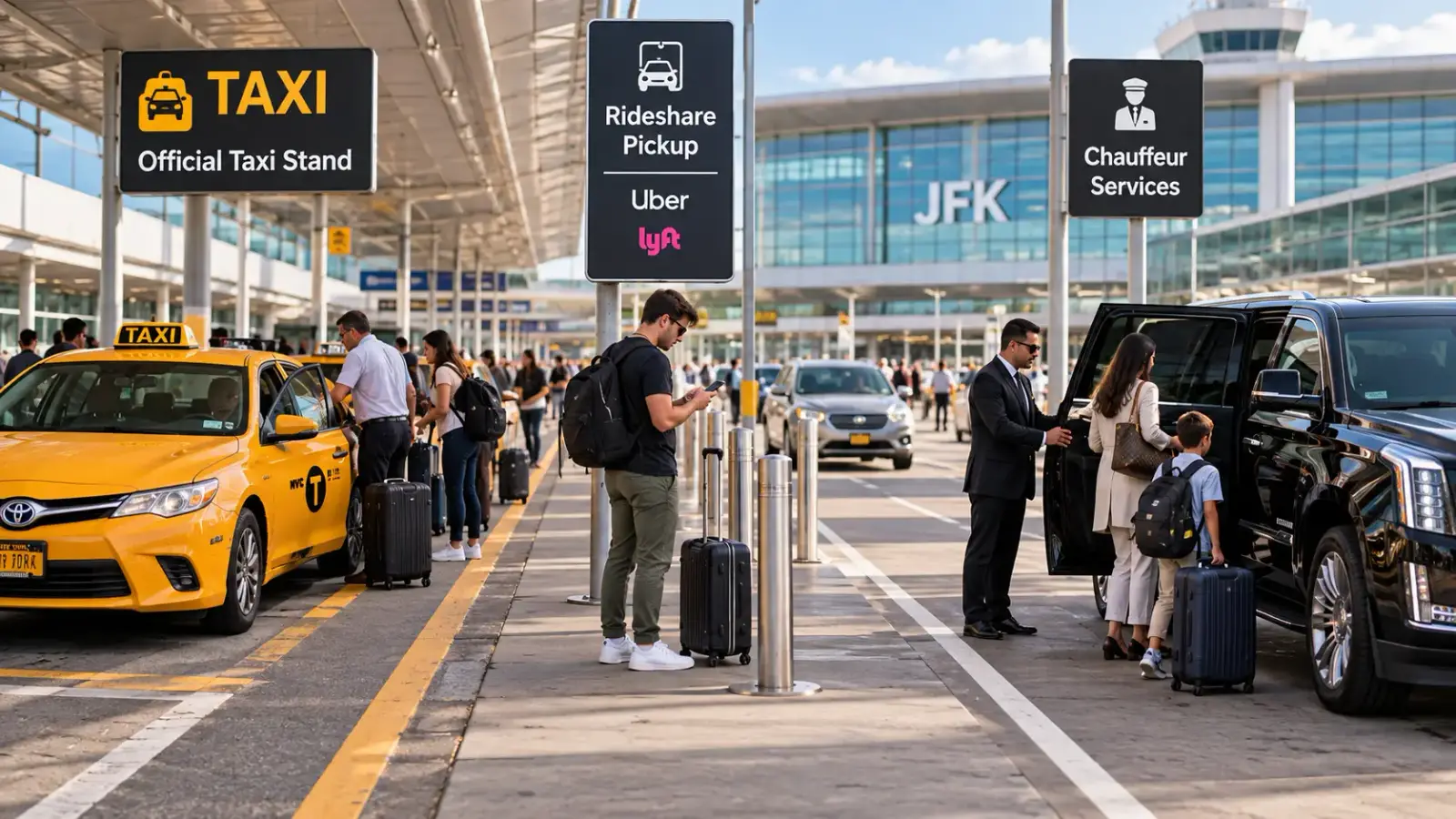
Yellow taxis provide one of the simplest walk-up transportation options at JFK because you do not need to make an advance reservation.
NYC's Taxi & Limousine Commission currently sets the yellow-taxi flat fare between JFK Airport and Manhattan at $70. For a pickup at JFK, additional mandatory charges can include the $2 airport access fee, $1 improvement surcharge, $0.50 MTA State surcharge, $2.50 New York State congestion surcharge and $0.75 Congestion Relief Zone taxi charge when applicable. A $5 weekday rush-hour surcharge applies from 4 PM to 8 PM. Tolls and tips are additional.
That means the commonly quoted "$70 taxi" is not the final amount you should budget.
For a typical Manhattan trip outside weekday rush hour, the required base fare and listed surcharges can already reach about $76.75 before bridge/tunnel tolls and gratuity. If the trip uses a tolled crossing such as the Queens-Midtown Tunnel, the final total increases further.
With a typical gratuity, a realistic total can therefore approach roughly the mid-$90s to around $100 on some Midtown trips, depending on the route and applicable toll.
Advantages
- No advance reservation required
- Official taxi dispatch areas at JFK
- Door-to-door transportation
- Flat base fare between JFK and Manhattan
Disadvantages
During busy arrival periods, there may be a wait before getting into a taxi. Unlike a pre-arranged chauffeur service, the vehicle is not specifically tracking your flight and waiting for your reservation.
Vehicle size and condition can also vary, which matters if you have several passengers or oversized luggage.
If your priority is simply walking outside and taking the next available vehicle, however, a yellow taxi remains a practical option.
Option 3: AirTrain + LIRR
For many solo travelers, AirTrain plus the Long Island Rail Road offers an excellent balance of speed and cost.
Take JFK AirTrain to Jamaica Station, then transfer to an LIRR train toward Penn Station or Grand Central Madison.
As of 2026:
- JFK AirTrain: $8.75
- LIRR CityTicket off-peak: $5.25
- LIRR CityTicket peak: $7.25
That puts the combined transportation cost at approximately:
- $14.00 off-peak
- $16.00 peak
The Port Authority confirms the $8.75 AirTrain fare, while the current MTA CityTicket fares are $5.25 off-peak and $7.25 peak.
Allow roughly 50–70 minutes from your terminal to central Manhattan once walking, waiting and transferring are included.
This option works especially well for:
- Solo travelers
- Passengers with a carry-on
- Travelers staying near Penn Station
- Midtown West hotel guests
- Travelers who prioritize avoiding highway traffic
The trade-off is convenience.
You still need to get from the Manhattan rail terminal to your hotel or apartment. That can mean another subway ride, taxi, bus or walk.
Luggage can also make station transfers less comfortable, particularly during crowded periods. Jamaica and key Manhattan stations offer elevators and accessibility features, but moving multiple suitcases through a rail journey is still less convenient than a direct vehicle.
Option 4: AirTrain + Subway
For budget-conscious travelers wondering how to get from JFK to Manhattan as cheaply as possible, AirTrain plus the subway is usually the answer.
The current fares are:
- AirTrain: $8.75
- NYC subway: $3.00
- Total: $11.75 per adult
JFK Airport and the MTA list the 2026 subway base fare at $3.00, while AirTrain costs $8.75 for travel between the airport and Jamaica or Howard Beach.
Two common routes are:
Via Jamaica:
Take AirTrain to Jamaica and connect with the E, J or Z subway depending on your destination.
Via Howard Beach:
Take AirTrain to Howard Beach and connect with the A train.
Allow approximately 60–90 minutes for most Manhattan destinations, although service changes, overnight schedules and transfers can extend the journey.
This is particularly suitable for:
- Backpackers
- Students
- Solo budget travelers
- Travelers familiar with NYC transit
It becomes less attractive when you have multiple large suitcases, young children, mobility limitations or a group large enough that individual transit fares begin adding up.
Rush-hour subway cars can also be crowded, so a flight arriving with several checked bags at 5 PM is very different from arriving with a backpack at 1 PM.
Option 5: Rideshare
App-based rideshare services offer another door-to-door option, but airport pickup procedures can be more complicated than requesting a vehicle elsewhere in New York.
JFK currently uses designated pickup arrangements, and construction can cause pickup locations to change. The airport specifically advises passengers to check their app for the latest pickup location.
Pricing is also dynamic.
Unlike a pre-booked flat-rate airport car where the trip price is confirmed in advance, rideshare pricing can change based on demand, weather, driver supply and time of day.
It can be convenient when demand is low.
It becomes less predictable during:
- Friday evening rush hour
- Severe rain or snow
- Major holidays
- Large flight-arrival waves
- Late-night periods with fewer available drivers
If using a rideshare, check both the estimated fare and pickup location before confirming.
JFK to Manhattan Drive Time by Time of Day
There is no single drive time that works for every arrival.
For planning purposes, these are reasonable door-to-door driving ranges:
| Time of Day | Typical Planning Range |
|---|---|
| Late night, 11 PM–5 AM | 35–50 minutes |
| Early morning, 5–7 AM | 40–55 minutes |
| Morning rush, 7–10 AM | 55–80 minutes |
| Midday, 10 AM–3 PM | 45–65 minutes |
| Evening rush, 4–7 PM | 65–90 minutes |
| Evening, 7–11 PM | 45–65 minutes |
These are planning estimates rather than guarantees. Accidents, roadwork, tunnel delays, weather and major NYC events can change travel times substantially.
If you have a meeting, cruise departure, Broadway reservation or another fixed appointment, leave extra time.
Main Routes From JFK to Manhattan
Your chauffeur or driver should choose the route based on current traffic rather than blindly following one fixed path.
1. Van Wyck → LIE → Queens-Midtown Tunnel
This is one of the most direct routes for JFK to Midtown.
Drivers generally take the Van Wyck Expressway north from the airport, connect with the Long Island Expressway and enter Manhattan through the Queens-Midtown Tunnel.
It works particularly well for Midtown East and central Midtown when traffic conditions cooperate.
2. Van Wyck → BQE → Williamsburg Bridge
For Lower Manhattan, SoHo, Chinatown and some Financial District destinations, routing through Queens and Brooklyn toward the Williamsburg Bridge can sometimes make more sense.
The best choice depends heavily on traffic.
3. Belt Parkway → Verrazzano → Hugh L. Carey Tunnel
This is significantly less direct for most Manhattan trips, but it can function as a backup when major incidents disrupt the usual Queens approaches.
Because it involves a much longer path and additional tolled crossings, it is not normally the first choice.
Real Cost Comparison
Consider a sample trip from JFK Terminal 4 to a Midtown Manhattan hotel at 9:30 PM on a weeknight.
At that time, the weekday 4–8 PM taxi rush surcharge would no longer apply.
| Option | Approximate Cost | What to Expect |
|---|---|---|
| Private car | Flat quote provided when booking | Door-to-door, no demand-based surge, reserved vehicle, flight tracking |
| Yellow taxi | $76.75 before route tolls and tip | $70 flat fare plus applicable fixed surcharges; tolls and gratuity additional |
| AirTrain + LIRR | $14.00 off-peak | AirTrain to Jamaica + off-peak CityTicket |
| AirTrain + subway | $11.75 | Cheapest option; more walking and longer overall journey |
The taxi calculation is based on the TLC's current JFK-Manhattan fare and applicable listed surcharges.
For rail, the current $8.75 AirTrain fare plus $5.25 off-peak CityTicket produces a $14 fare, while AirTrain plus the $3 subway fare totals $11.75.
The important point is not that one option always wins.
A solo traveler staying beside Penn Station may reasonably choose the LIRR.
A family of four with six suitcases arriving after an international flight may place much more value on a reserved SUV meeting them at the airport.
Which Option Should You Choose?
Business traveler or tight schedule: Pre-book a private car.
Family, group or several suitcases: Private SUV or Sprinter van is usually the easiest door-to-door option.
Solo traveler near Penn Station: AirTrain + LIRR provides strong value.
Budget traveler with light luggage: AirTrain + subway is usually the lowest-cost choice.